Insurtech’s first real win and the emerging industry realignment behind it
.png)

On May 6, 2026, Allianz Commercial announced that it would transition its entire standalone commercial cyber insurance business to Coalition and make the company its exclusive global partner for commercial cyber across every segment. Trade press covered it as a business move, filed it under partnerships and M&A, and moved on.
We should examine what this really means as a major milestone in the insurtech narrative. One of the largest insurers on the planet looked at its own cyber portfolio, saw what a technology-first Managing General Agent ("MGA") was doing with the same risk, and concluded that the MGA should run the book outright. Pricing, product development, risk mitigation, and claims management all move to Coalition. Allianz keeps the balance sheet, its brand, and its distribution, and yields the underwriting. The commitment runs for a minimum of 10 years, with triggers tied to loss-ratio performance. A decade-long commitment on these terms that leaves the MGA independent appears to be a first. The financial structure is worth slowing down to understand. Coalition is paying for the exclusive right to manage the book, and the currency is equity in Coalition itself. Allianz is separately putting in cash, taking a board seat to align the two companies, and can earn additional equity based on how much cyber premium it channels to Coalition through its own distribution.
Put plainly, a top-four insurance incumbent decided a startup should underwrite a major division of its business and committed to that for a decade. The startup even paid, in its own equity, for the exclusive right to run the book. That has never happened at this scale in commercial insurance. The rare part is that an incumbent admitted a specialist could underwrite one of its own lines better than it could. Applied broadly, it shows technology's real edge now reaches past distribution into underwriting itself: sharper risk selection, smarter pricing, better loss results. We should be talking about this a lot more than we are.
Bigger than one deal
Allianz and Coalition are the loudest example of a shift that has been building across the entire property-casualty market for five years, but its significance goes far beyond just these two companies. The MGA, treated for decades as a niche player in the distribution chain, has become the fastest-growing and arguably the most interesting part of the insurance industry.
Author's note: the terms "MGA" and "MGU" are often used interchangeably. For the purposes of this post, I use "MGA" throughout as the broader category, with the understanding that some MGAs own more of the underwriting than others.
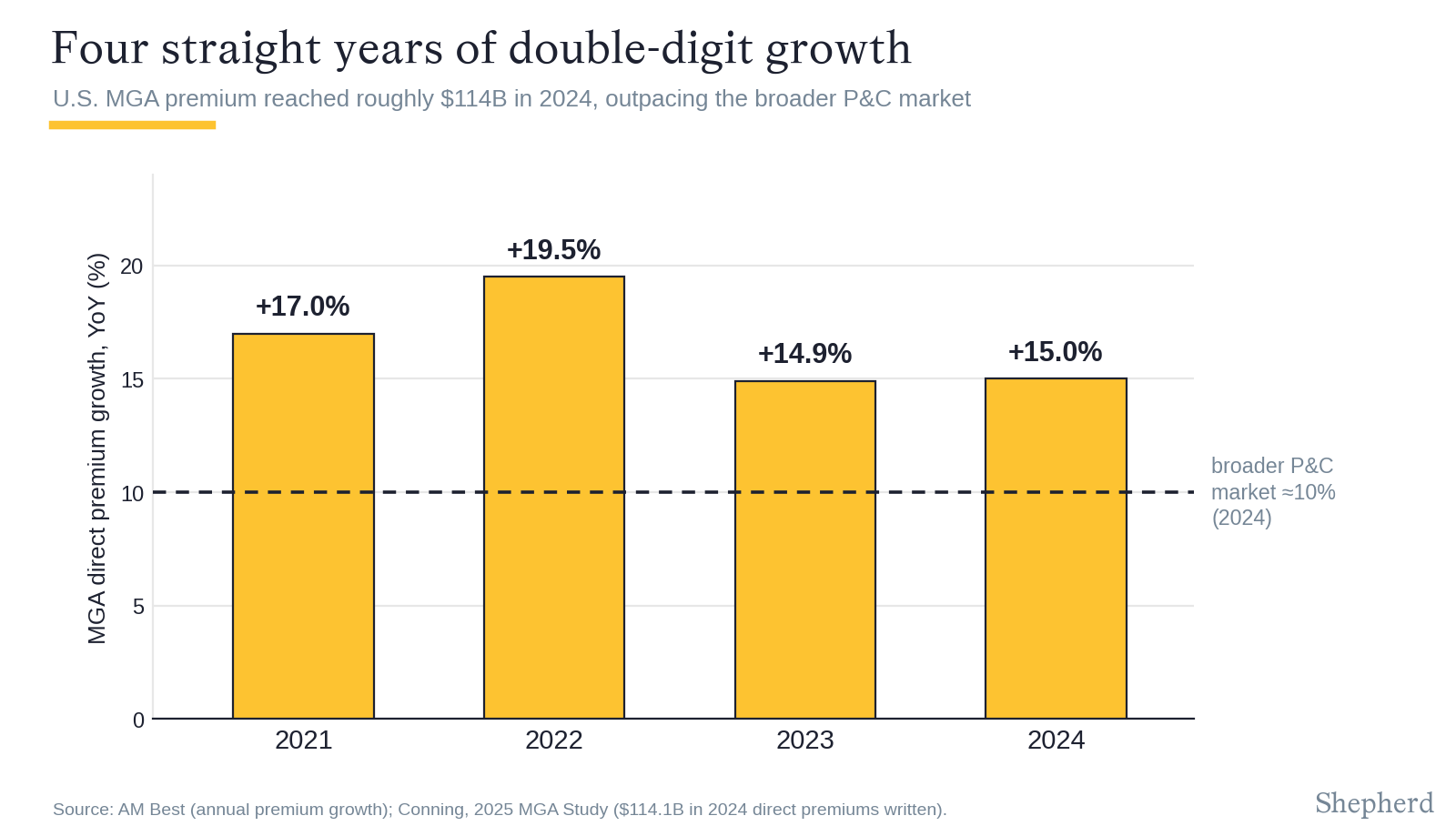
U.S. MGAs wrote roughly $114 billion in premium in 2024, up 16 percent in a year when the broader P&C market grew around 10 percent. That was the fourth straight year of double-digit growth, a cumulative expansion of close to 90 percent over the period. MGAs now account for about a tenth of the U.S. P&C market, up from roughly seven percent a few years ago. Insurers are leaning in rather than resisting: in Conning's recent industry survey, more than nine in 10 said they are deepening their use of MGA partnerships.
Private equity and venture capital have noticed too. Private equity now owns more than 30 percent of U.S. MGA entities, drawn by asset-light structures, fee-based revenue, and EBITDA margins in the 20 to 30 percent range. Venture capital has poured into the sector's technology, with more than $60 billion invested into insurtech since 2012 and funding turning back up in 2025, to about $5 billion, after several lean years. When capital moves toward a model this quickly, it is reading a few important signals about the industry.
MGAs have an underwriting advantage
For most of its history, the MGA was understood as a distribution arrangement. A carrier wanted access to a market without building the infrastructure, so it handed a pen to someone with local relationships and specialized knowledge. The carrier held the power because the carrier held the paper and the capital. The MGA was the junior partner.
That balance is inverting. The structure that is winning now puts the technology-native underwriter in control of the part that actually compounds: the data, the models, the pricing, the risk selection, the claims handling, the loss prevention. The carrier provides what carriers are built for: the balance sheet, the ratings, the regulatory machinery, and the distribution that took a century to build, the captive channels, the multinational accounts, and the standing with the world's largest brokers. Each side does what it does best, and when the two are aligned through mutually beneficial economics, the combination beats either one operating alone.
The Allianz–Coalition deal is the clearest statement of that new balance anyone has made. Allianz is doing far more than renting out its paper for a fee. It is taking equity in the underwriter and a board seat, while Coalition has paid for the exclusive right to run the book. Each side now owns part of the other's outcome. The paper has become the input. The technology and the underwriting have become the franchise.
There is a distribution story here that is easy to miss. A young, often mono-line MGA cannot readily build what Allianz already owns: captive channels, multinational accounts that buy broad coverage, and relationships with the largest brokers in the world. Allianz was never comfortable underwriting cyber at scale, so much of that demand went unwritten. Handing the pen to Coalition turns latent demand into premium, and the additional equity Allianz can earn is tied to how much of it flows through its channels. The incumbent's distribution and the MGA's underwriting are each worth more in the other's hands.
Are MGAs still “undisciplined?”
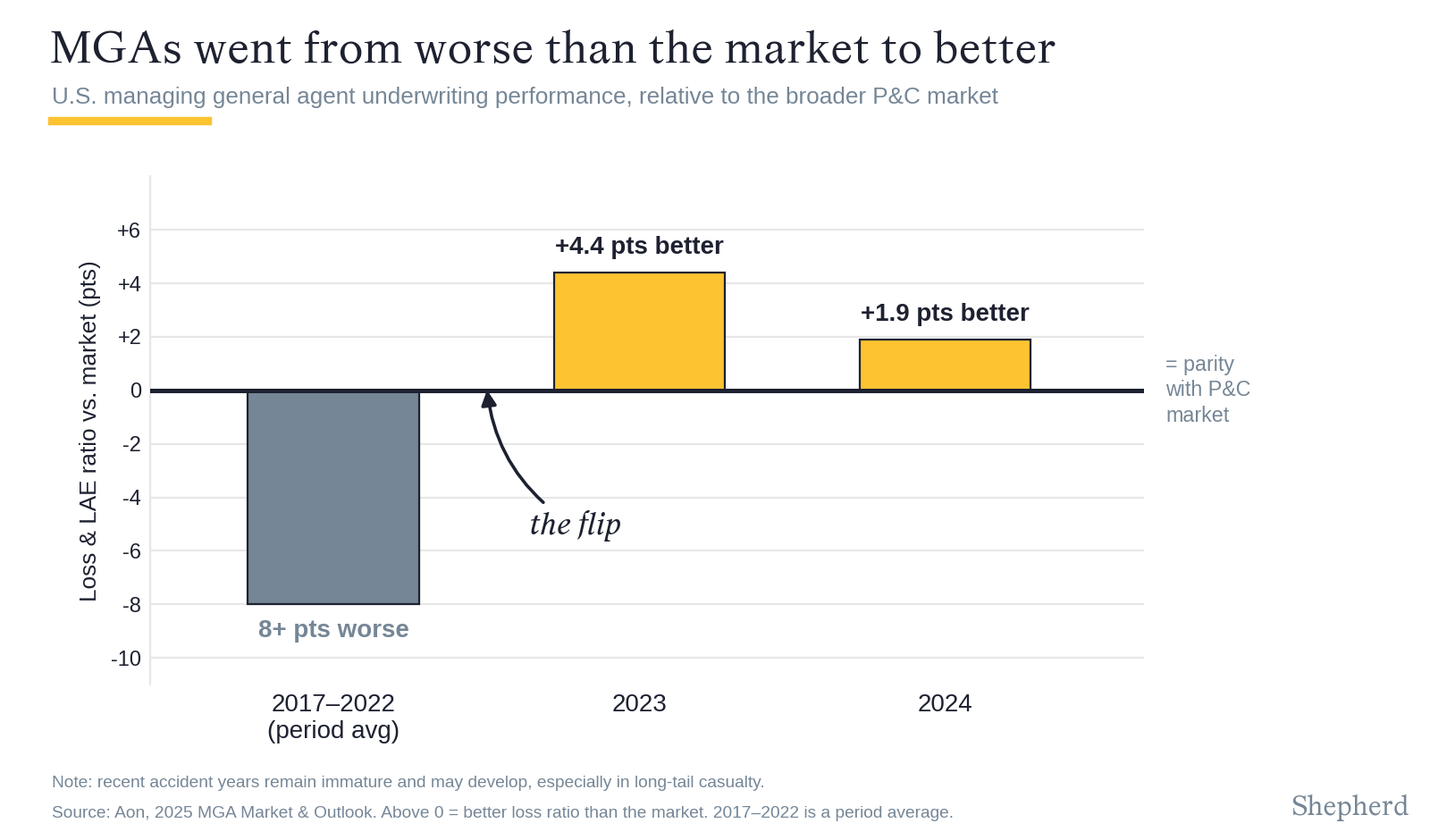
The objection to outsourcing underwriting authority used to be about quality. The story went that MGAs chased premiums, wrote lower quality risks that carriers would not touch, and ran worse loss ratios as a result. For a while the data agreed. From 2017 to 2022, MGA loss-and-expense ratios ran more than eight points worse than the broader market.
Then the gap began to close, and by 2023 and into 2024 MGA loss-and-expense ratios were running a few points better than the market. That reversal deserves caution, because two recent accident years are a thin and immature base, especially in long-tail casualty, where losses can develop upward for years after a policy is written. The steadier signal sits in the longer record: over a ten-year horizon, MGA books have outperformed the market in casualty and motor. The specialist model tends to produce better results when it is given time to work, because focus and data beat breadth in the lines that are genuinely hard to underwrite.
No one has pushed that model further than Coalition, which is why it ended up at the center of the biggest deal. Their approach, which they call Active Insurance, treats underwriting as a live data problem instead of a static one. It continuously scans the internet for exposed assets and known vulnerabilities, prices risk against a real-time picture of an insured's security posture, and keeps scanning after the policy binds to warn policyholders before a weakness becomes a loss. The underwriting engine and the loss-prevention engine are the same engine, which shows up in the loss results. Coalition has reported claims frequency among its policyholders running 60 to 70 percent below the market average, with loss ratios consistently strong enough that capacity providers kept extending their commitments.
The industry spent a decade waiting for this proof point, and it explains why the most famous insurtech experiments disappointed. The full-stack carriers that captured the headlines, the ones that went public promising that “machine learning will remake insurance!” took the balance-sheet risk on themselves in commoditized personal lines where data advantages are thin and price competition is brutal. The results did not cooperate. Loss ratios stayed high, losses ran into the billions across the category, and share prices fell sharply from their debuts.
Much of the market read the last decade as proof that technology cannot change insurance outcomes. The better explanation comes down to aim and structure. Those companies pointed powerful technology at commoditized lines and carried the capital risk themselves, while the MGAs that aimed the same tools at hard, data-rich specialty lines and left the capital to the carriers delivered the results the category had promised all along.
Cyber was first but it won't be the last
Cyber became the proving ground for a reason. It is the line where a static, point-in-time view of risk is most dangerous, where losses move fastest, and where a live data engine pays for itself soonest. That made it the first place a technology-native underwriter could open a lead wide enough that a global carrier would reorganize around it.
The same conditions exist elsewhere. Specialty casualty, property in catastrophe-exposed geographies, commercial auto, professional and management liability, all of these are complex, data-rich, and poorly served by legacy approaches, and premium already flows toward delegated underwriting structures across them. Recent hard-market conditions accelerated the shift, but the structural logic outlasts any cycle. Once an MGA builds a genuine data and underwriting edge in a line, the book it creates tends to persist long after rates soften.
So the Allianz–Coalition deal is best read as a template: a technology-native underwriter builds a defensible edge in a hard line, proves it with loss results over several years, and a carrier with capital and regulatory status restructures around it. That pattern is going to repeat across specialty insurance, and the next decade of this industry will be shaped by how many carriers understand it and how well they execute.
Maybe I’m wrong
The strongest argument against the MGA model goes after the structure itself. There is a well-funded school of thought that holds that real innovation in insurance means owning the whole stack, that underwriting, pricing, capital, claims, and reinsurance belong in one place, because only the company that carries the risk has its incentives fully aligned and can iterate on the product end to end. By that logic, an MGA that rents a balance sheet and collects a commission is a middleman, technology only creates a more sophisticated version of the program administrators that have existed for decades, and the durable move is building a better insurance company rather than a better front end. Corgi announced its Series B on exactly that thesis the same day the Allianz–Coalition deal landed. "The hard part is owning the risk. Everything else is arbitrage."
Even if the MGA model is the right one, there is another bear case that holds: the structure carries a genuine incentive problem. An MGA earns its money on the premium it writes, while the carrier and its reinsurers absorb the losses when the underwriting is wrong. Profit commissions and slides narrow that gap without fully closing it. An MGA's worst case is losing a contract. The capital provider's worst case is paying claims. Rating agencies have started expressing this noticeably. Morningstar DBRS has flagged the operational, governance, and counterparty risk that MGA growth pushes onto fronting carriers, who keep only 10 to 20 percent of the premium and cede the rest. AM Best now runs a formal performance assessment for MGAs. Carriers are tilting toward non-exclusive arrangements.
The larger risk is the cycle. The MGA boom rode one of the hardest markets in a generation, and rented capacity behaves differently when rates fall. Notably, Cyber has already softened, with rates down more than 20 percent from their 2022 peak. When a soft market arrives in earnest, capacity providers can reprice, demand more retention, or walk. The MGA feels this first because it needs someone else's balance sheet to write anything at all. The model has not been tested through a full down cycle across commercial P&C at this scale. Even the performance flip deserves an asterisk. Aon attributes much of the recent MGA outperformance to favorable catastrophe experience in commercial property, and the gap is already narrowing, from 4.4 points in 2023 to 1.9 in 2024. Some of the win is skill. Some of it is the weather.
What the next soft market will prove
Two years of better loss ratios, helped along by mild catastrophe seasons, do not settle whether the insurtech thesis holds across lines and segments. The soft market that is coming will say more about the MGA model than the hard market that built it. And the Allianz deal can be read two ways at once: as proof that the technology-native underwriter is the new franchise, or as an outlier, a win that says more about cyber than about the model. Cyber is the most technological line in insurance, a digital risk you can scan and reprice in near real time, and a software-first underwriter's edge there may not carry into slower, more physical lines like property or liability.
What the full-stack critique gets right is that owning the risk matters. What it gets wrong is the assumption that a single company has to own all of it to capture the value of better underwriting. The Allianz structure is interesting because it splits that difference. Coalition takes the economic and reputational consequences of its own results through profit-sharing, and still draws on a global balance sheet for scale it could not build alone in a decade.
So I will hold the claim, with the edges sanded down. I build in this space, so I am not a neutral observer. The MGA model has not won the argument outright, but it has earned its first proof point at global scale: a technology-native underwriter produced results good enough that one of the largest insurers in the world chose to rebuild its global cyber operation around them, take equity, and tie a meaningful portion of its own fortunes to the result. That has never happened before. Whether it turns out to be the destination or a waypoint, it is the first real win.